
Signs your heating needs a power flush
- Radiators are hot at the top but cold at the bottom or in the middle.
- Water released when you bleed a radiator is black or brown.
- The boiler is noisy, bangs or "kettles" while heating.
- The heating takes a long time to warm the house.
- The boiler keeps breaking down, or a new boiler is about to be fitted.
These symptoms are caused by magnetite sludge and limescale. Steel radiators slowly corrode from the inside, and the black sludge settles in radiators, blocks pipework and coats the boiler's heat exchanger. London's hard water adds limescale to the mix.
How a power flush works
- Assessment. We check the system's age, pipework and radiator valves, because some older systems need a gentler clean.
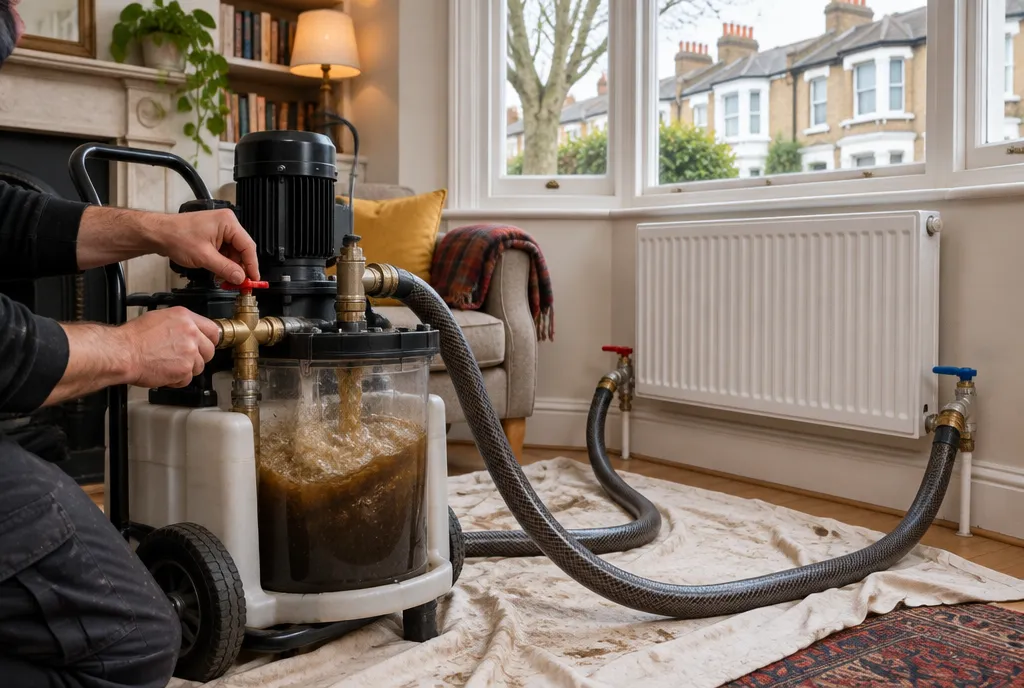
- Connection. The power flushing unit is connected to the heating circuit, usually at the pump or a radiator.
- Chemical clean. A cleaning chemical is circulated to loosen sludge and scale.
- Radiator by radiator. Each radiator is flushed in turn, with the flow reversed to dislodge debris, until the water runs clear.
- Protection. The system is refilled with inhibitor, and we recommend a magnetic filter to catch new sludge before it reaches the boiler.
A power flush on an average house usually takes most of a day. Dust sheets go down before any hoses come out, and the work area is left clean.
Honest advice about power flushing
A power flush is not always the answer. If only one radiator is cold, the problem may be a stuck valve or trapped air. If the system is very old and fragile, a gentler chemical clean may be safer. We tell you which option your system actually needs.